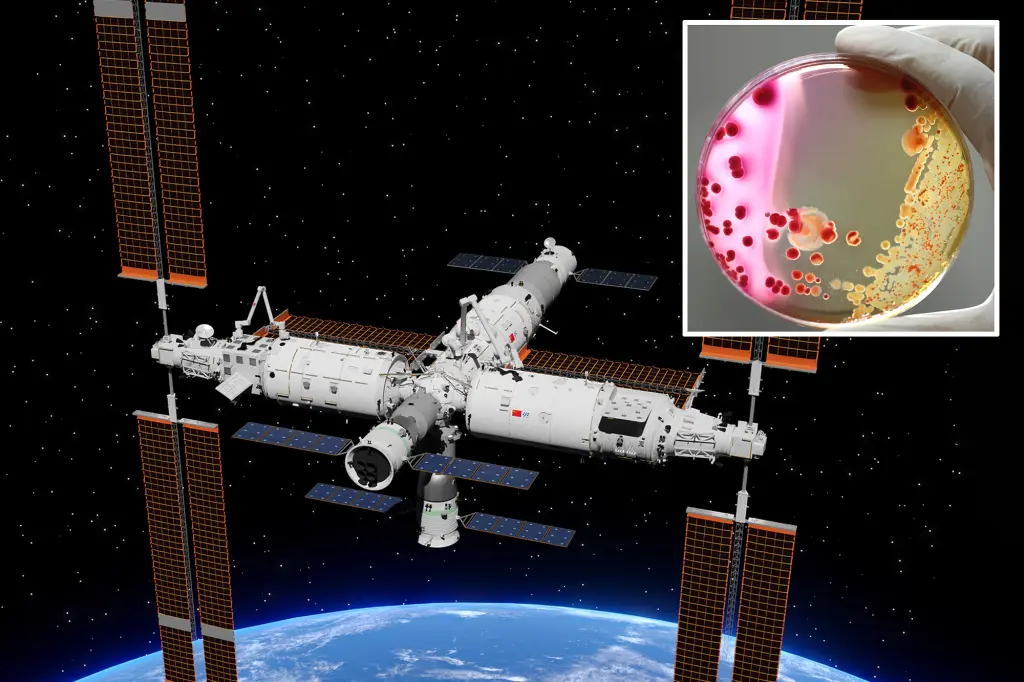

Bacteria are microscopic organisms that are found everywhere. But have you ever wondered what if there are bacteria in space? Yes, you heard it right. A new bacterial species, Niallia tiangongensis, has been discovered in the China space station, Tiangong. Tiangong is a three-module space station in lower Earth orbit. It was under the Shenzhou 15 mission.
In May 2023, during the Shenzhou-15 mission, astronauts collected swab samples from the inner surfaces of Tiangong’s cabin. When analyzed back on Earth, researchers identified a completely new bacterial species, which they later classified as Niallia tiangongensis. This organism belongs to the Cytobacillaceae family within the genus Niallia. The discovered bacteria exhibit unique adaptations to survive in space environments.
Genomic sequencing and phenotypic analysis confirmed its novelty, with unique metabolic pathways and stress-adaptation mechanisms. Its discovery represents one of the first documented cases of a new species being described from a space habitat.
Morphology and Taxonomic Features
Niallia tiangongensis is Gram-positive, aerobic, rod-shaped, and spore-forming. These features mirror survival strategies under the stressors of microgravity and space radiation. It can hydrolyze gelatin for carbon and nitrogen. This novel trait suggests a potential adaptation to nutrient-limited conditions on the space station.
Adaptations to the Space Environment
The unique physiology of N. tiangongensis provides insights into how microbes respond to the extreme conditions of space:
- Spore Formation –Protects against UV radiation and limited nutrients.
- Biofilm Development – Facilitates adhesion to spacecraft surfaces and protection from cleaning agents and radiation.
- Oxidative Stress Response – Enhances survival despite high levels of cosmic radiation.
- Metabolic Flexibility – The Ability to utilize unconventional substrates like gelatin to survive.
Risk and potential threats:
While N. tiangongensis is a scientific milestone, its presence also raises potential concerns:
Human Health Risks: A close relative, N. circulans, is associated with opportunistic infections such as sepsis. Although no direct pathogenicity has been reported yet.
Spacecraft Integrity: Biofilm formation by bacteria in space can lead to material degradation, clogging of water recycling systems, and contamination of life-support units.
Planetary Contamination: The detection of new bacteria raises the risk of accidental transfer of Earth microbes to extraterrestrial environments.
Biotechnological Opportunities
Despite the several risks, N. tiangongensis could be a great tool for biotechnological benefits and applications:
- It is capable of waste recycling and oxygen production that may support long-duration missions by creating self-sustaining ecosystems.
- Robust bacteria could serve as biological “factories” for producing vitamins, enzymes, and bioplastics during missions that helps in reducing dependency on Earth resupply.
- Engineered strains may help detoxify harmful byproducts of space.
- Studying microbial adaptation provides models for life in space.
Comparisons with Other Space Microbes
This discovery is not only one recognition. Previous studies aboard the International Space Station (ISS) have shown various bacteria in space with specificity.
Salmonella becomes more virulent in microgravity
Enterobacter bugandensis enhanced antibiotic resistance.
These discoveries makes N. tiangongensis apart is that it is not merely a mutated Earth strain but a formally recognized new species. This marks a milestone in space microbiology.
Future Directions in Space Microbiology
The discovery of N. tiangongensis opens various prompts for future research:
- Continuous sampling of space stations to observe microbial evolution throughout space.
- Decode the genomic code that is responsible for stress tolerance, biofilm formation, and metabolic shifts within space.
- Genetically Engineering microbes with controlled traits to support space missions.
- Strengthening sterilization methods to prevent cross-contamination between Earth and space.
Conclusion
The discovery of Niallia tiangongensis in space is more than a microbiological discovery. It is a key to the window into life’s resilience in extreme environments. This novel bacterium not only challenges microbial limits but also plays a crucial dual role of microbes in space as potential threats and key collaborators.
For biotechnology and space science, this research is a new frontier. As we are preparing for the deep-space mission, understanding microbes like N. tiangongensis may prove as critical as rockets and living habitats themselves.


xkztgxrryingqgmwnhirzliqrffqdy
qklkxfgyvmiilyosvzpsmlfjqxdqii
tqlmrndvkeiepdesephgyvihxpxtuq
zhdkpyhzwypuwkqpojvlfthqgnzlso
mgfvrftjoiskwttztjtnwmumwxmdsq